
Loading...
Loading...
Feb 27, 2026
Performance-Based Façade Design (PBFD) 2026 will take place in Venice, Italy, September 16–18, 2026. Now in its fourth year, the theme of the event is “Durable Façades.” The event will focus on the global construction industry, which is being asked to deliver facades that are complex technically, contractually, and operationally — and that will meet requirements today but remain reliable and safe for decades.
Under a partnership with ASTM International, PBFD 2026 connects the durability agenda to the practical, measurable domain of serviceability through a dedicated workshop, “Façade Serviceability: Failures and Lessons Learned,” and a publication pathway via an ASTM Selected Technical Papers (STP) volume that will be presented at PBFD 2027.
Astrid Piber, partner at UNStudio, and Silvia Prandelli, senior principal at Populous, will deliver keynotes for the event, at the seminar on “Durable Façades” that will open PBFD 2026. Topics include (but are not limited to):
The PBFD 2026 “Workshop on Façade Serviceability: Failures and Lessons Learned” will address the technical and operational space where durability is validated — or challenged — through real-world performance, and will provide a case-driven forum focused on field evidence, diagnostic methods, and lessons learned. At the workshop, Andrei Koshelev, AIA SIA, will deliver a keynote titled “Durable Façade: A Client Perspective.”
PBFD 2026 welcomes submissions for seminar presentations aligned with “Durable Façades”; workshop contributions aligned with “Façade Serviceability: Failures and Lessons Learned”; and off-site activity proposals aligned with PBFD 2026 themes.
The abstract submission deadline for all tracks is April 5, 2026.
Submissions can be made via the PBFD Call for Abstracts form found at: www.performancebasedfacadedesign.org/2026. Abstracts should clearly communicate:
Selected authors and organizers will be invited to present their work during the event in Venice. Workshop speakers are also invited to develop full papers for consideration within the ASTM STP publication pathway.
For additional information about the conference, or to become a sponsor, please contact event organizers Angela Mejorin at amejorin@performancebasedfacadedesign.org or Daniel J. Lemieux at dlemieux@wje.com.
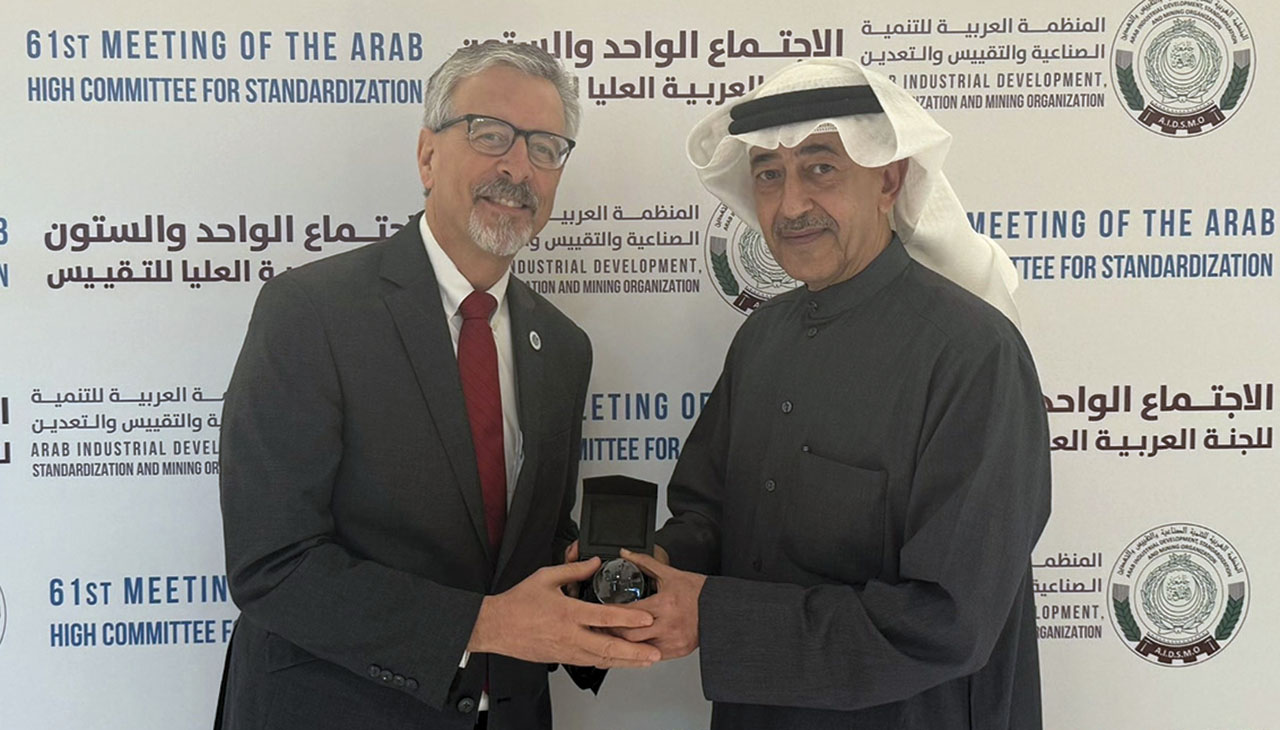
ASTM International recently participated in the 61st Meeting of the Arab High Committee of Standardization at the meetings of the Arab Industrial Development Standardization and Mining Organization (AIDSMO LAS) in Rabat, Morocco.
The meetings provided a valuable forum for dialogue, with remarks from James Olshefsky, ASTM’s head of global outreach, and the opportunity to recognize the collaboration through a presentation to AIDSMO’s Director General H.E. Eng. Adel Al-Saqer. The event helped strengthen cooperation in support of regional and international standardization.
ASTM International recently announced its participation in a newly awarded Allied Additive Manufacturing Interoperability (AAMI) project led by America Makes and the National Center for Defense Manufacturing and Machining (NCDMM). Funded by the Office of the Under Secretary of Defense for Research and Engineering’s Manufacturing Technology Office (OSD(R&E)), the $1.1 million initiative aims to establish additive manufacturing (AM) equivalency and interoperability between U.S. Department of Defense (DoD) and U.K. Ministry of Defence (MoD) supply chains.
The AAMI program focuses on laser powder bed fusion (LPBF) of critical defense parts and seeks to identify barriers to allied interoperability while supporting the development of shared, international qualification and certification approaches. As a member of the Lockheed Martin–led project team, working alongside Additive Manufacturing Solutions Ltd (UK)., ASTM will contribute its global expertise in standards development, qualification frameworks, and data interoperability. This work will be driven by ASTM’s Global Advanced Manufacturing Division, with technical support from the ASTM International U.K. team.
This project reflects a growing emphasis on allied, distributed manufacturing models that can respond to complex logistical and sustainment challenges. While AM offers clear advantages in lead time reduction, design flexibility, and
on-demand production, scaling AM for defense applications requires consistent qualification pathways, trusted data exchange, and alignment across national supply chains.
“The future of defense manufacturing depends on interoperability — not just of technologies, but of standards, qualification approaches and trust,” said Mohsen Seifi, Ph.D., vice president of global advanced manufacturing programs at ASTM. “Through this collaboration, ASTM is helping to enable a common technical language between U.S. and U.K. partners so that qualified AM parts can be produced with confidence across allied supply chains.”
ASTM’s involvement will be supported in part by ASTM’s U.K. branch, the organization’s regional hub established to accelerate additive and advanced manufacturing (AM) qualification, standardization, and industrial adoption across the U.K. and Europe. The U.K. team brings direct experience working with government, industry, and research partners on defense, aerospace, and industrial AM programs.
“AM equivalency between allied nations is essential for resilient defense sustainment,” said Ben DiMarco, technology transition director for America Makes. “By working with our partners and member organizations, we’re advancing qualification frameworks that support real-world adoption and ensure consistent, reliable parts across U.S. and U.K. operations.”
ASTM’s involvement in this program reflects its growing role in enabling defense industries globally through a combination of standards development, technical advisory services and training, pilot programs, qualification frameworks, and international collaboration.
ASTM International has been awarded a new project under the NATO Accelerating Interoperability and Standardization (AIS) Fund titled “Unmanned Surface Vehicles (USV) Standardization: Current Status and Future Outlook.” The project supports NATO’s efforts to enhance interoperability, operational readiness, and future capacity by advancing coordinated approaches for unmanned surface vehicle (USV) technologies.
The project leverages ASTM’s global expertise in advanced manufacturing, technical frameworks, and defense-focused collaboration to support NATO’s evolving maritime capability needs. The project’s objective is to identify gaps and opportunities related to USV standardization and associated frameworks, and to provide practical guidance and recommendations to NATO to help inform future standardization priorities and capability development activities. As part of this effort, the project team will review relevant NATO and non-NATO standards, certification approaches, and enabling frameworks – and will propose pathways for strengthened collaboration with external standards development organizations (SDOs), industry, and other stakeholders across the defense industrial base ecosystem.
ASTM’s participation reflects its growing role in enabling defense industries globally through a combination of standards development, technical advisory services and training, pilot programs, qualification frameworks, and international collaboration. ASTM’s cooperation with NATO builds upon an existing memorandum of understanding that provides a formal foundation for advancing interoperability and alignment across defense technologies.
The project is delivered by a consortium led by INTRACOM DEFENSE S.A. (IDE), serving as the Implementing Agent and primary contractor. IDE is a Greece-based defense systems company with a strong track record in national defense programs and exports to international customers. The consortium also includes Defence Standardization Advice P.C. (DEFSTAND), a Greek small- and medium-sized enterprise with specialized expertise in interoperability and standardization management.
“Defense readiness depends on more than standards alone. It requires trusted technical frameworks, collaboration across borders, and the ability to translate innovation into deployable capability,” said Dr. Mohsen Seifi, vice president of global advanced manufacturing programs at ASTM International. “ASTM’s advanced manufacturing programs team is excited to collaborate with our European partners to drive innovation and standardization for USV technology that bolsters the future capacity of the NATO alliance. This project reflects our broader commitment to supporting defense stakeholders with the tools, partnerships, and expertise needed to move emerging technologies from concept to operational reality.”
Beyond NATO, ASTM actively collaborates with the European Defence Agency (EDA), particularly in the area of additive manufacturing, supporting defense innovation, qualification, and industrial scale-up. ASTM also works closely with the U.K.’s Ministry of Defence (UK MoD) across multiple fronts, including advanced manufacturing, digitalization, and emerging technologies, helping connect government, industry, and academia to accelerate defense capability development.
Through its global programs and partnerships, ASTM continues to expand its role in supporting defense innovation, interoperability, and resilience across critical and emerging technology domains.
ASTM International has opened the Call for Abstracts for the 2026 ASTM International Conference on Advanced Manufacturing (ICAM 2026), to be held Sept. 28 – Oct. 2, 2026, at the Hyatt Regency Orlando in Orlando, FL.
Hosted by ASTM’s Additive Manufacturing Center of Excellence (AM CoE) and supported by ASTM technical committees and global partners, ICAM 2026 is the AM CoE’s flagship event. It serves as ASTM’s forum for industrial deployment of additive and advanced manufacturing technologies, including technological breakthroughs, leading-edge use cases, driving standards, and qualification pathways.
Now entering its second decade, ICAM has become a key event for technical decision makers in AM. ICAM sees research, policy, and industry practice intersect, supporting the transition of advanced manufacturing (AM) from early research through qualification and scalable adoption across critical sectors.
ICAM 2026 will feature 24 technical symposia spanning four major program pillars:
Important dates for ICAM 2026 include:
Detailed symposium descriptions, submission guidelines, and deadlines are available on the ICAM 2026 website.
ICAM 2026 will again feature a Student Research Showcase, including competitive oral presentations, poster sessions, and non-competitive oral presentation opportunities, providing students with direct exposure to industry leaders and subject-matter experts. Updated guidelines and deadlines for student participation are available online.
In addition, ICAM 2026 offers sponsorship and exhibitor opportunities designed to connect organizations with decision-makers across the AM ecosystem through technical sessions, networking events, and targeted engagement.
Authors are encouraged to submit abstracts and participate in shaping the ICAM 2026 technical program. Learn more and submit your abstract at: https://amcoe.org/icam26.
About the AM CoE
The AM CoE is a collaborative partnership representing industry, government, and academia to conduct strategic R&D to advance AM standardization. The center also aims to accelerate development and adoption of AM by developing training and certification programs, and providing market intelligence, business strategy, and advisory services through Wohlers Associates, powered by ASTM International.
In January, Elvin Chia, ASTM’s director of outreach, Asia, presented at the ASEAN 2050 Sustainable Aviation Fuel (SAF) Outlook Report Launch Conference in Vietnam.
Chia’s presentation, “The Role and Importance of International SAF Standards,” focused on critical global standards such as the specification for aviation turbine fuel containing synthesized hydrocarbons (D7566) and the standard practice for evaluation of new aviation turbine fuels and fuel additives (D4054).
During the trip, Chia met with colleagues from the National Commission for Standards, Metrology and Quality (STAMEQ) to discuss opportunities to deepen the long-standing partnership between both organizations.
In February, Chia participated at APEC’s Asia-Pacific Economic Cooperation Subcommittee on Standards and Conformance (SCSC) plenary meeting in Guangzhou, China. During the meeting, he highlighted ASTM’s initiatives in clean energy, sustainability, emerging technologies, and capacity building.
In August, ASTM will be conducting an APEC workshop on “Building Resilient Communities: Advancing Standards for the Built Environment.”March / April 2026


