

Loading...
Using Artificial Intelligence (AI) on ASTM standards and related intellectual property is prohibited. Violations will result in suspension of access.
By Tim Sprinkle
Mar 12, 2026
Think about the last time you boarded a plane, drove across a bridge, or filled up your car at a gas station supplied by a buried pipeline. Chances are, none of those structures were ever cracked open or physically pulled apart to verify their integrity – yet they functioned properly. That is because many structures like these are examined using a category of technology known as nondestructive testing, a broad family of inspection methods that can detect flaws, measure material properties, and assess structural soundness without ever touching or damaging the object being examined.
It is a field that operates quietly in the background of industries ranging from aerospace and energy to manufacturing and defense. And like many fields, it is now in the middle of a digital transformation.
ASTM International's committee on nondestructive testing (E07) recently took steps to help smooth that transition with two revised standards focused on DICONDE (digital imaging and communication in nondestructive evaluation), an international standard for managing, storing, and exchanging digital nondestructive testing (NDT) data. The DICONDE framework was established by the subcommittee on DICONDE (E07.11) in 2004 as part of E2339. That standard created a unified data format for storing, transferring, and archiving industrial imaging data across various NDT methods.
The revised standards are the guide for DICONDE (E3169) and the standard practice for DICONDE for ultrasonic test methods (E2663).
“It's a vendor-neutral file format,” says Andrew Ferro, chair of E07.11 and a principal engineer at GE Aerospace. “But it's also a transmission protocol. That means you can transfer data from one system to another even if they're different manufacturers, because they both follow a standard and can talk to each other. That's called interoperability."
The DICONDE framework is based on the DICOM system (digital imaging and communications in medicine) that hospitals around the world use to store and share medical images like MRIs, X-rays, and CT scans for universal access.
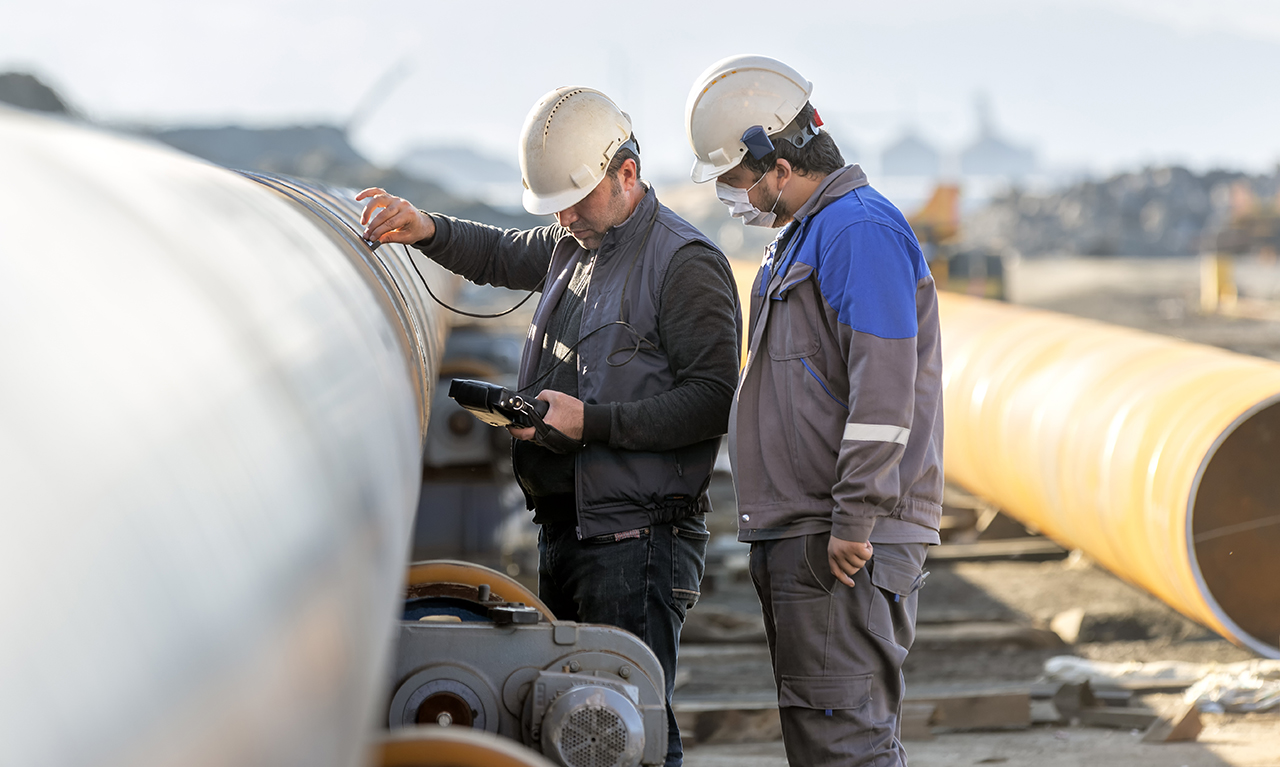
Nondestructive testing is driven by constraints. You need to know whether a weld is sound, whether a turbine blade has developed a microscopic crack, or whether a pipeline has begun to corrode from the inside – but you can’t disassemble the aircraft, drain the pipe, or melt down the part to find out. Instead, inspectors use ultrasonic, radiographic, and other scanning techniques to look inside materials and detect anomalies they cannot see with the naked eye.
The data those inspections generate – including images, waveforms, metadata, and more – has historically been stored in proprietary formats tied to specific vendors. That created a problem, as not all data was available to all systems. DICONDE was created to eliminate that concern by ensuring that everything captured by the NDT process is interoperable and available to all.
"Now we're guaranteed that we'll be able to read our data 15 years from now,” Ferro says, “because it was written in a standard format as opposed to some proprietary format that might go away when the company goes away. We want all of our inspection equipment to be able to talk to each other and all be able to upload to a common archive, where we can view it and retain all that data for years to come."
To support the development of DICONDE in NDT, E07.11 recently revised two of the format’s foundational standards.
The next step for E07.11 is adoption, getting industry and regulators to align around these revised standards and put them to work in the real world.
Says Ferro, “DICONDE ensures that customers will always have access to the data they create without fear of not being able to read proprietary formats without software support.” ●
Tim Sprinkle is a freelance writer based in Colorado Springs, CO. He has written for Yahoo, The Street, and other websites.


